
FTG Collector’s Notebook #004
The Forgotten Seiko Astronaut Watch Is Back — 44 Years Later
Long before smartwatches, touchscreens and app menus, Seiko came up with a wonderfully strange idea:
What if you controlled a digital watch by turning the bezel?
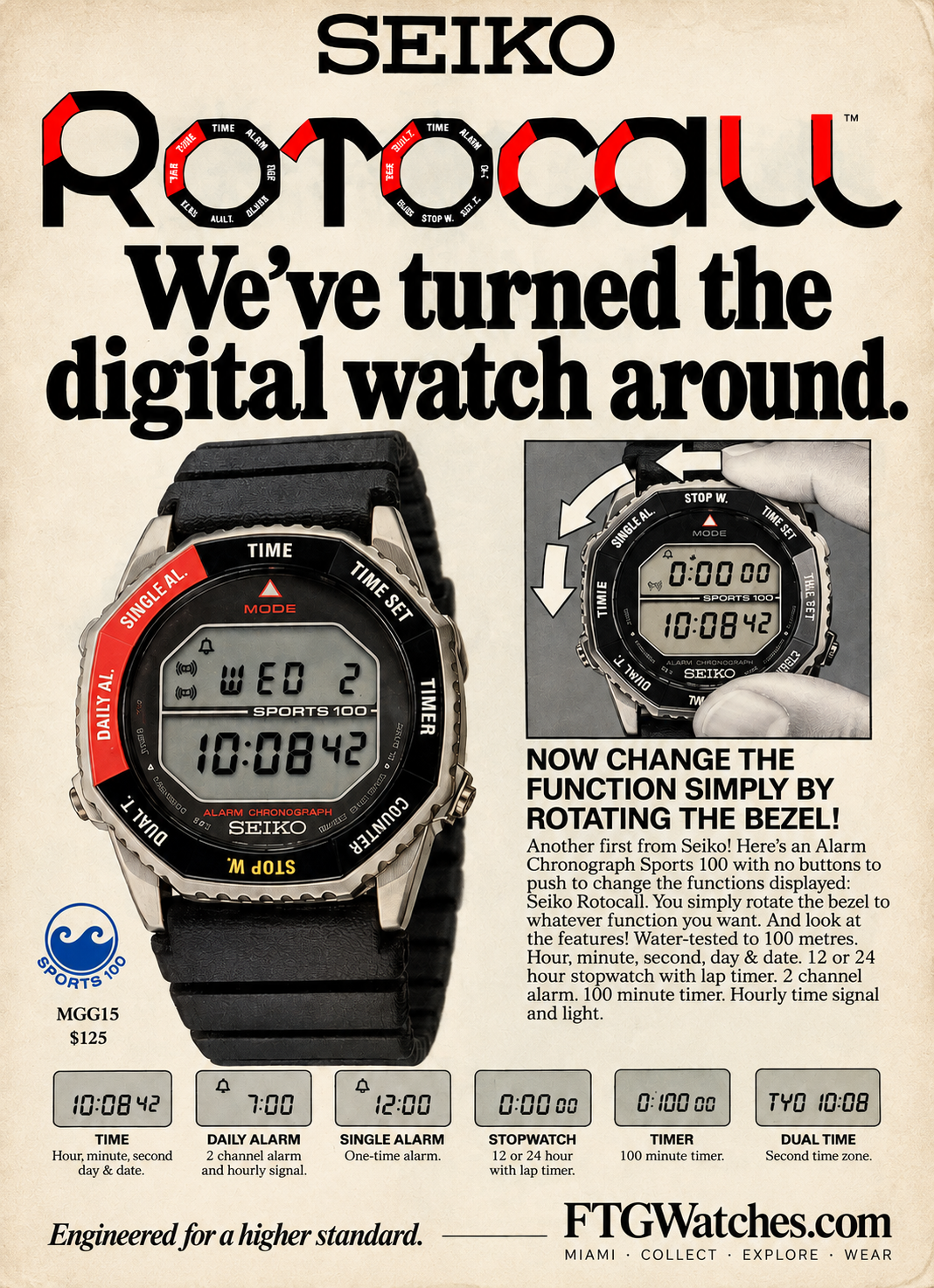
In 1982, Seiko introduced a digital watch that collectors would come to know as the Rotocall. Instead of covering the case with buttons, Seiko incorporated an octagonal rotary switch that allowed the wearer to change functions simply by rotating it.
Alarm. Timer. Stopwatch. Different modes were selected from the wrist with a twist of the bezel.
It was futuristic, unconventional and unmistakably 1980s.
And then something happened that gave this peculiar digital Seiko an entirely different kind of credibility.
Astronauts started wearing it.
Now, 44 years after the original appeared, Seiko has returned to the Rotocall for its 145th anniversary with the HFL001, a 4,000-piece limited edition arriving in October 2026.
For collectors accustomed to Seiko divers, GMTs and mechanical chronographs, this may look like an odd detour.
It isn't.
The Rotocall represents another side of Seiko history—one that collectors are only beginning to rediscover.
Seiko Wasn't Just Building Mechanical Watches
When enthusiasts talk about vintage Seiko, the conversation usually follows a familiar path.
The 62MAS.
The 6139 automatic chronograph.
King Seiko and Grand Seiko.
The Tuna.
Those watches deserve their reputations, but they tell only part of the story.
By the late 1970s and early 1980s, Seiko was pushing aggressively into electronic watchmaking. Quartz had already transformed the industry, and digital watches offered manufacturers an entirely new playground.
The question was no longer simply how accurately a watch could tell time.
It was:
What else could a watch do?
That period produced some of the strangest and most imaginative watches Seiko ever made.
The Rotocall was one of them.
Turn the Bezel. Change the Watch.
The original Rotocall appeared in 1982.
Its defining feature was an octagonal rotary control surrounding the digital display. Rotate it and the watch switched between different functions.
It sounds ordinary today because we're accustomed to navigating menus on electronic devices.
In 1982, it was anything but ordinary.
Seiko had essentially created a physical user interface for the wrist.
Instead of repeatedly pressing tiny buttons and remembering combinations, the wearer could rotate the selector toward the desired function.
It was intuitive, mechanical-feeling and strangely satisfying despite controlling an electronic watch.
More than four decades later, it still looks futuristic.
Then Came the Astronauts
This is where the story becomes particularly interesting for collectors.
Seiko itself notes that the Rotocall became well known internationally partly because of its popularity among astronauts.
That association helped transform what could have become another forgotten 1980s digital watch into something with genuine enthusiast mythology.
Space-connected watches occupy a special corner of collecting.
The Omega Speedmaster is obviously the giant of the category, but collectors also chase lesser-known watches connected with astronauts, pilots, engineers and space programs.
The Rotocall approaches that history from a completely different direction.
It wasn't a traditional mechanical chronograph.
It was a digital tool from an era when electronic technology represented the future.
In that context, seeing it on an astronaut's wrist suddenly makes perfect sense.
The Rotocall Returned in 2025
There's an important distinction with the new watch.
The HFL001 isn't technically the first Rotocall revival.
Seiko brought the design back in 2025, recreating the unusual rotary-switch concept in modern production models.
For Seiko's 145th anniversary in 2026, however, the company has taken that revived platform and created something considerably more distinctive.
The result is the HFL001.
And visually, subtle is not the word.
Edo Purple Meets 1980s Digital
Seiko has used Edo purple as a recurring theme across several of its 145th-anniversary watches.
On the HFL001, the color appears prominently on the rotary control surrounding the display.
The rest of the watch goes in the opposite direction.
The stainless-steel case and bracelet receive a black hard coating, while gold-colored Seiko branding and function markings add another layer of contrast.
Black.
Purple.
Gold.
Digital LCD.
It shouldn't necessarily work.
Somehow, it does.
And unlike many anniversary watches that merely change a dial color, the HFL001 begins with a design that's already unusual enough to be instantly recognizable.
The Specifications Are Surprisingly Serious
Underneath the retro styling is Seiko's Caliber A824 quartz movement.
The watch includes a 1/100-second chronograph capable of timing up to 100 hours, a countdown timer, alarm, dual-time display, LED illumination and a full automatic calendar programmed through December 31, 2074.
Battery life is approximately three years.
The case measures a very wearable 37mm in diameter, 43.5mm lug-to-lug and 10.6mm thick.
Water resistance is 10 bar / 100 meters.
The crystal is Hardlex.
And yes—the rotating bezel remains the star of the show.
Production is limited to 4,000 pieces worldwide.
Seiko lists the HFL001 at $595 in the United States, with release scheduled for October 2026.
Is 4,000 Really Limited?
Collectors should always be careful with the words “Limited Edition.”
Four thousand watches isn't microscopic production.
But rarity isn't the only thing that creates collectibility.
Sometimes the more important ingredient is distinctiveness.
There are thousands of conventional Seiko divers.
There are thousands of black-dial automatic watches.
There aren't many watches that look like a black-and-purple 1980s digital instrument controlled by an octagonal rotating selector and descended from a model associated with astronauts.
That matters.
A collectible watch doesn't always need to be objectively rare.
Sometimes it simply needs to be difficult to replace with anything else.
The Other Seiko Collection
Perhaps that's the real reason the Rotocall deserves attention.
Seiko collecting is enormous.
But most collectors repeatedly circle the same categories: divers, chronographs, Grand Seiko, King Seiko and increasingly GMTs.
Beyond them exists another Seiko universe.
Digital watches.
LCD chronographs.
Talking watches.
TV watches.
Calculator watches.
Ana-digi experiments.
Space-connected references.
And dozens of strange electronic designs created during the period when Japanese manufacturers were trying to figure out what the wristwatch of the future should become.
Some experiments disappeared.
Others influenced what came afterward.
And a few became cult objects.
The Rotocall belongs in that last category.
The Collector's Question
So here's the question:
Can a quartz digital watch become genuinely collectible?
For decades, much of traditional watch collecting treated mechanical complexity as the primary measure of importance.
But younger collectors are increasingly looking at watches differently.
Design matters.
Cultural history matters.
Technology matters.
Nostalgia matters.
And provenance certainly matters.
The Rotocall has all four.
The HFL001 may contain a battery rather than a mainspring, but its story stretches from the experimental digital-watch culture of 1982, through its association with astronauts, to Seiko's 145th anniversary in 2026.
Forty-four years later, that strange rotating bezel still doesn't look quite like anything else.
Maybe that's precisely why Seiko brought it back.
And maybe collectors should be paying attention.
FTG Collector's Notebook is an ongoing series from FTG Watches, exploring the watches, history, technology and unusual references that make watch collecting interesting.
Sometimes the story behind the watch is what makes the watch worth collecting.